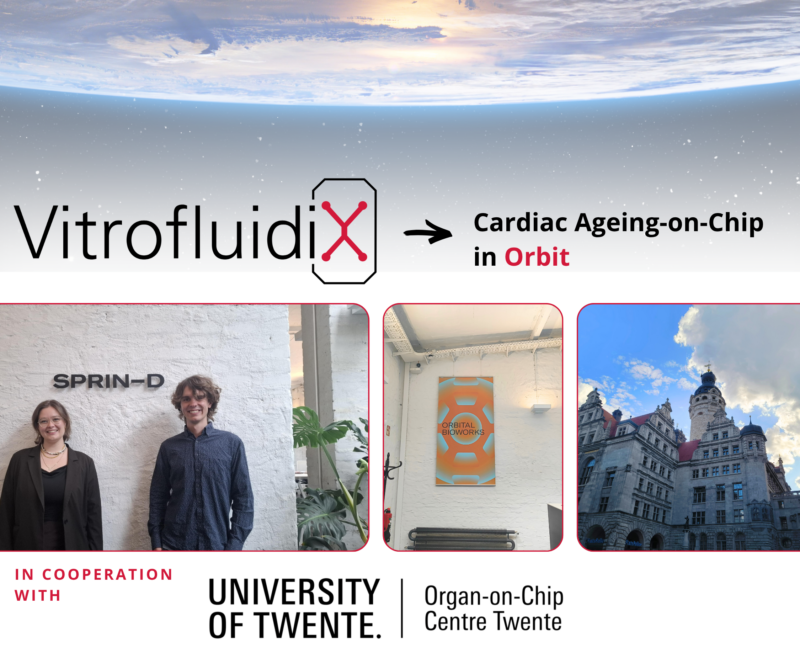
VitrofluidiX has been selected as one of 12 teams for the SPRIND Orbital BioWorks Challenge! Over the next four months, we will be adapting our Organ-on-Chip platform for autonomous operation in microgravity as part of our CACAO – Cardiac Ageing-on-a-Chip project.
🚀 Why space?
Microgravity can trigger physiological changes that resemble ageing-related processes on Earth – but on a much shorter timescale. This makes space a unique environment to study mechanisms that would otherwise take months or years to develop.
💡 Why Organ-on-a-Chip?
Organ-on-a-Chip enables us to expose complex, human-relevant tissue models to these conditions in a controlled environment – and ultimately use them to study disease mechanisms and test potential drugs or countermeasures.
🫀 Why cardiac ageing?
Cardiovascular safety is a major challenge in drug development. An accelerated, human-relevant cardiac ageing model could therefore provide a powerful new tool to study ageing mechanisms and test drug candidates and cardioprotective therapies.
Together with Joshua Loessberg-Zahl, Andries van der Meer, and Tomas van Dorp from the University of Twente and its Organ-on-Chip Centre, we are combining their advanced cardiac tissue model with our chip-agnostic VitroFlow platform. Together with Yuri, we are now adapting the system for autonomous operation in microgravity.
Our goal is to develop a scalable, modular, and ISO-compatible Cardiac Ageing-on-a-Chip platform for space. ✨
A huge thank you to SPRIND, Yuri, the jury, and everyone involved. We are looking forward to an exciting journey and to exploring how space can accelerate biomedical research. 🫶